The adding room
CALCTRONS
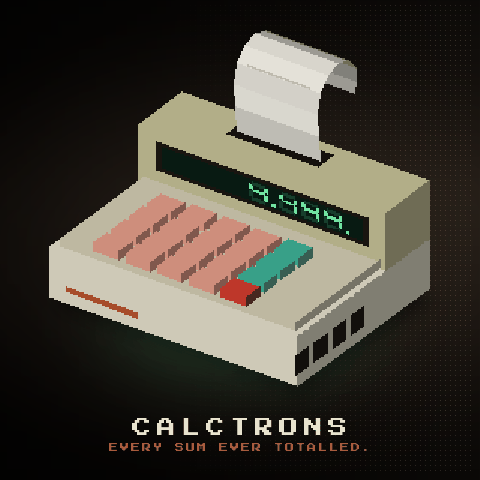
4,444 machines that ran the numbers before computers did. One token is one machine. Burn the token and the machine is memorized — permanent, and printing tape for as long as the pool trades.
THE DROP
Minting happens on OpenSea. This page only reports what the drop contract says.
THE CENSUS
Memorizing burns the one liquid $CALC token backing a machine. A burned token can never come back, so every unit is always in exactly one of two states: liquid and tradable, or memorized and earning. Liquid plus memorized always equals 4,444.
THE LIQUID ERC-404 MARKET
THE MACHINE'S RECORD
All-time tape printed
The running sum of trading-fee rewards generated for memorized machines, plus marketplace royalties. It is a lifetime total, not an unclaimed balance, and it only moves when the pool trades.
LIVE FEE QUEUES
Every buy and sell pays a permanent 3% fee, taken on the WETH side by the pool's own hook rather than by this website. Two thirds of it becomes tape for memorized machines; the rest compounds locked liquidity, buys and burns $STONKBROKER, and pays the creator.
THE TEN REGISTERS
Every machine is assigned to one of ten registers — M1 through M10 — and earns that register's tokenized stock once queued fees are converted. Each register holds exactly 444 machines with an identical tier mix, and receives an equal share of every conversion run. Fewer memorized machines on a register means a larger slice each.
FROM THE CATALOG
Fine calculating machinery deserves fine print advertising. Four models, drawn from the century when arithmetic was furniture.
THE MACHINES
THE FOUR RELICS
Four machines carry no register assignment. Three basket relics split a fixed slice of every conversion across all ten stocks; the Golden Curta takes its own cut and is paid in all ten directly. Ids 4441 to 4444.
THE DESKS
Canonical market
StagedOne CALC/WETH pool. Every trade crosses the same immutable fee hook — the token refuses to settle anywhere else.
Memorizing
StagedBurn the liquid token backing a volatile machine and it becomes permanent. One-way: no deployed function un-memorizes a machine.
The relics
4 of 4Three basket relics and the Golden Curta accrue across all ten registers instead of holding one.
Broker boost
PlannedHold a STONK BROKER and every standard machine you have memorized earns at 1.25× weight, read live from the Broker contract.
DOCS
In one paragraph
$CALC has 4,444 units and never any more. Hold one whole unit and a machine is drawn to your wallet from the unclaimed pool; drop below a whole unit and your newest draw dissolves back into it. Burn the token behind a machine you hold and the machine is memorized — it leaves the tradable float for good and starts printing tape. Every buy and every sell pays a permanent 3% fee, taken on the WETH side by the pool's own hook rather than by this website. Two thirds of that fee becomes tape for memorized machines; the rest compounds locked liquidity, buys and burns $STONKBROKER, and pays the creator.
That is the whole system: a gacha for the people who flip, a one-way commitment for the people who stay, and a fee engine that cannot be routed around, feeding the ones who committed. Every section below expands one of those claims.
The vocabulary
The words are ours on purpose. A machine is not in a standard ERC-721 state and calling it one would hide the part that matters. Every term used on this page:
- Machine
- One of the 4,444. A calculating machine drawn as pixel art, always in exactly one of two states, never both and never neither.
- Volatile
- Backed by one liquid $CALC. It trades, it rerolls, it earns nothing. The default state of everything the moment it is drawn.
- Memorized
- The backing token has been burned. The machine can no longer dissolve, its display lights, and it earns its register's stock from that block onward.
- Register
- M1 through M10. Every standard machine is assigned to exactly one, and the register decides which tokenized stock it earns. Fixed before launch.
- Tape
- The converted stock paid out to memorized machines. A lifetime total on The Machine's Record, not an unclaimed balance.
- Relic
- Ids 4441 to 4444. Four machines that predate the register system and are paid across all ten instead of holding one.
- Weight
- How large a slice of a register's conversion a memorized machine takes. Set by tier and never changes.
- The pool
- The single canonical $CALC/WETH market. The token refuses to settle anywhere else; see the routing lock.
How it works
Hold a whole token
$CALC has only 4,444 units. Hold one whole liquid token and a volatile machine is drawn from the unclaimed pool and appears in your wallet, already assigned to one of the ten registers. Fractions do nothing: the balance has to cross a whole unit before a machine materializes.
Reroll if you want a different machine
Sell below a whole token and your most recent volatile machine dissolves back into the pool. Buy back and you draw a different one. That is the gacha half — the odds are the pool's live composition, and the pool is public state, so the odds are checkable at any moment rather than promised.
Memorize to make it permanent
Burn the token backing a machine you own. The machine can never dissolve again, its display lights, its tape starts running, and it begins earning its register's stock from that moment. This is irreversible: no deployed function un-memorizes a machine.
The tape prints
Trading fees queue in WETH and convert to the ten stocks in bounded runs. Each register sends the bulk of its converted stock to the memorized machines on that register by weight; the relics take the rest. Rewards travel with the machine when it changes hands.
The float shrinks, the claimants grow
Every memorize moves one unit out of the tradable float and adds one permanent earner. Memorizing is most attractive early on a register and self-limits as the register fills — an equilibrium, not a flywheel.
The machines and their weights
Every machine is a real device from the history of calculation, drawn as 8-bit pixel art. Rarer machines carry more reward weight. Every register holds the same tier mix — 245 / 133 / 53 / 13 — so no register is a better lottery ticket than another.
| Tier | Machine | Supply | Weight |
|---|
The 1958 Ten-Key had no display worth the name: you entered a column of figures and the answer came back on a paper slip, because forming characters electronically cost more than the arithmetic did. The Desk Unit put the register drum behind glass. The 800 brought nixie tubes, and the Busicalc 141-PF — built around one of the first calculator chip sets — is the machine that ended the mechanical era it belongs to. The four Relics predate displays entirely.
Drawing and rerolling
A machine is drawn when your balance crosses up through a whole unit, and it is drawn at random from whatever is still unclaimed. Nobody picks. A T1 draw can be rerolled toward a T4 by cycling the balance down and back up, at the cost of the 3% fee each way plus price impact — which is exactly why rerolling funds the people who stopped rerolling.
The draw is pseudorandom and we say so plainly: it comes from block state, not from an oracle. It is unpredictable enough for a gacha whose prizes all share one fee stream, and every draw is publicly auditable afterwards. It is not a commit-reveal lottery and does not claim to be.
Dissolution is newest-first. As your balance crosses down through whole units, the most recently drawn volatile machine goes back to the pool first. Memorized machines are untouched by any token movement — that is the entire point of memorizing.
Memorizing
Volatile machines are liquid: they trade, they reroll, they earn nothing. Memorizing burns the single $CALC backing a machine you own. In exchange the machine becomes permanent, its display lights and animates, and it starts earning its assigned register's stock.
It is one way. There is no function in any deployed contract that un-memorizes a machine. Memorizing is not staking: staking implies a position you can unwind. What you keep is the machine and its claim on future fees. There is no unbonding, no escrow, and no way back.
Memorizing needs the full 1.0 $CALC in the caller's wallet. Transferring a volatile machine as an NFT moves its 1.0 backing along with the id; transferring a memorized machine moves the claim, and any unclaimed tape with it.
The 4,444 invariant
Liquid plus memorized always equals 4,444. Not approximately, and not by convention — a unit is either a token in the float or a permanent claim on that float's trading, and moving between the two is what memorizing is.
So each memorize does three things at once. The float shrinks, because one token is burned. The reroll pool shrinks, because one machine can no longer be drawn by anybody. The claimant set grows, because one more machine is now earning. The fee stream is generated by the liquid float and consumed by the memorized set, and every memorize moves one unit from the generating side to the consuming side. That tension is the design, not a side effect of it.
The fee engine
The permanent base fee is 3% of WETH-side volume, taken by the hook inside the swap itself. The pool's own LP fee is forced to zero and the protocol fee replaces it, so this is a swap fee and not a transfer tax: ordinary wallet-to-wallet transfers pay nothing. The carve is fixed in the contract, not in this page:
| Stream | Of the fee | Of volume |
|---|---|---|
| Tape for memorized machines and relics | 66.6667% | 2.0000% |
| Locked liquidity, reinvested permanently | 21.2500% | 0.6375% |
| $STONKBROKER buyback and burn | 7.0833% | 0.2125% |
| Creator | 5.0000% | 0.1500% |
The three retained streams accumulate in destination-locked pots on the hook: only the tape sink can pull the tape pot, only the burn vault can pull the burn pot, only the liquidity vault can pull the liquidity pot. There is no general sweep function, and no address that can point a pot somewhere else. The creator's share is taken inside each swap with no custody step at all.
Registers and epochs
Each standard machine has one assigned register, and the register decides which of the ten tokenized stocks it earns. Every register holds exactly 444 machines with an identical tier mix, and every register receives an equal share of each conversion run. What differs is how many machines on that register are memorized.
That is the part worth understanding before you memorize anything: a fully lit register splits its inflow 444 ways, and a register with ten lit machines splits the same inflow ten ways. Fewer memorized machines on a register means a larger slice each. Early per-machine rates are therefore not representative of later ones, and we would rather say that here than have it discovered later.
Conversion runs in bounded epochs: queued WETH converts to the ten stocks, each register's share is credited to its memorized machines by weight, and the relics take their fixed slice across all ten. The converter can only send stock to the tape contract — the destination is immutable.
The four relics
Ids 4441 to 4444 carry no register. Three of them split a fixed slice of every conversion across all ten stocks; the Golden Curta takes its own larger cut and is paid in all ten directly. They are one of one each.
| Id | Machine | Stream once memorized |
|---|---|---|
| 4441 | The Pascaline (1642) | 0.083% of all volume |
| 4442 | The Arithmometer (1851) | 0.083% of all volume |
| 4443 | The Comptometer (1887) | 0.083% of all volume |
| 4444 | The Golden Curta (1948) | 0.10% of all volume, paid as all ten stocks |
A relic earns nothing until it is memorized, exactly like every other machine. Its share can accrue while it is still volatile, but only a memorized owner can claim it — which means a relic sitting dark has been quietly filling up the whole time.
Claiming
Tape accrues continuously against your machine; claiming only transfers what has already accrued. There is nothing to time and no penalty for waiting, beyond the gas.
Unclaimed tape travels with the machine when the NFT is sold. A seller can claim immediately before a sale, so a buyer should re-check the pending balance at the moment of execution rather than at the moment of listing. Volatile machines have nothing to claim.
The routing lock
There is one canonical $CALC/WETH pool and the token will not settle anywhere else. During each swap through the registered pool the hook writes a settlement allowance into the token, bound to the exact direction and amount of that swap and stored so that it cannot outlive the transaction. A pool that never touches the pool manager cannot obtain one, so it cannot be seeded at all.
Older-style pairs are refused by runtime codehash instead — an owner action that can only ever target contract code, never a person. Externally owned accounts have no bannable codehash by construction, so wallet-to-wallet transfers can never be blocked. The lock constrains pools, not people.
We will state the limit rather than oversell it: the codehash ban is reactive. A genuinely novel AMM would work until it was identified and banned. In practice meaningful off-route liquidity is hard to bootstrap and arbitrage returns volume to the deep canonical pool — but that is an economic tendency, not a contract guarantee.
Verification
Robinhood Chain, chain id 4663. Every address below is published here and links to verified source once deployed. Nothing on this page is a number we typed in by hand: the status strip and the drop panel are read from the chain by this server and inlined into the first response, so what you see on the first frame is what the chain said.
| Contract | Address | What it does |
|---|---|---|
| $CALC | Published at launch | The token and the machines. One contract, two states. |
| Fee hook | Published at launch | Takes the 3% inside the swap and splits it into destination-locked pots. |
| Tape sink | Published at launch | The only address that can pull the tape pot. Credits machines by weight. |
| Router | Published at launch | The canonical route. Public infrastructure — there is no key to ask for. |
| Collection | Published at launch | The drop. Minting happens on OpenSea, not here. |
Which machine each id is, which register it earns, and its art were all fixed before launch. Nothing can be reassigned afterwards.
Risks
- Tape is a reward, not a dividend. Distributions to memorized machines are promotional rewards for taking part in the protocol. They are not dividends, not investment income, and they confer no equity, ownership, or share of profits in any company — including the companies whose tokenized stocks trade on this chain.
- Memorizing is irreversible. The burned token is gone whether or not the protocol ever earns another cent.
- Rates dilute. Every new memorized machine adds a permanent claimant while removing liquid supply from the float that generates the fees. Early per-machine rates are not representative of later ones.
- Rewards depend on volume that may never arrive. No trading, no fees, no tape. The mechanism works perfectly and pays nothing.
- The tokenized stocks are somebody else's contracts. They are issued by a third party and their issuer can pause or alter them. That risk passes through to anything denominated in them.
- Conversion is keeper-initiated. Fees accrue safely in destination-locked pots if operations stop — nothing is stealable, because each pot can only be pulled by its sealed sink — but nothing pays out until conversion runs again.
- The routing lock is enforced, not absolute. Canonical settlement is enforced and known alternate venues can be blocked, but arbitrary future contracts cannot honestly be called impossible.
- Jurisdiction. Access to tokenized-stock products is restricted in some places, including the United States region. Checking your own eligibility is your job, not ours.
- This is experimental software. Never risk more than you can afford to lose completely.
Questions people actually ask
Is memorizing just staking?
No. Staking implies a position you can unwind. Memorizing destroys the token permanently; what you keep is the machine and its claim on future fees. There is no unbonding, no escrow, and no way back.
Can I choose which machine I get?
Not by buying $CALC — the draw is random from whatever is unclaimed. You can buy a specific machine on a secondary market instead: a volatile one arrives with its 1.0 $CALC backing, a memorized one arrives with its claim.
What happens to my machines if I sell part of my balance?
Volatile machines dissolve newest-first as the balance crosses down through whole units. Memorized machines are untouchable by token movement.
Do rewards keep accruing if I never claim?
Yes. The accumulator credits your machine continuously and claiming only moves what has accrued. If you sell the NFT, the pending amount goes with it — though a seller can claim right before the sale, so check at execution time.
Is a relic worth holding while it is still volatile?
It accrues while dark, but only a memorized owner can claim. A relic that has been sitting volatile since the first trade has been filling up the whole time and paying nobody.
Why is the fee on the WETH side?
Because a transfer tax would tax people moving their own tokens between their own wallets. A swap fee taken by the hook inside the pool touches trades and nothing else.
Where do I mint?
On OpenSea. This site is documentation and live state; it never asks for a signature and never moves funds. The drop panel above links straight to the collection.
Are the tokenized stocks real shares?
No. They are tokenized stock products issued by a third party on this chain — not shares held in your name, and not a claim on any company.